Supplement Certificate of Analysis: How to Read a COA
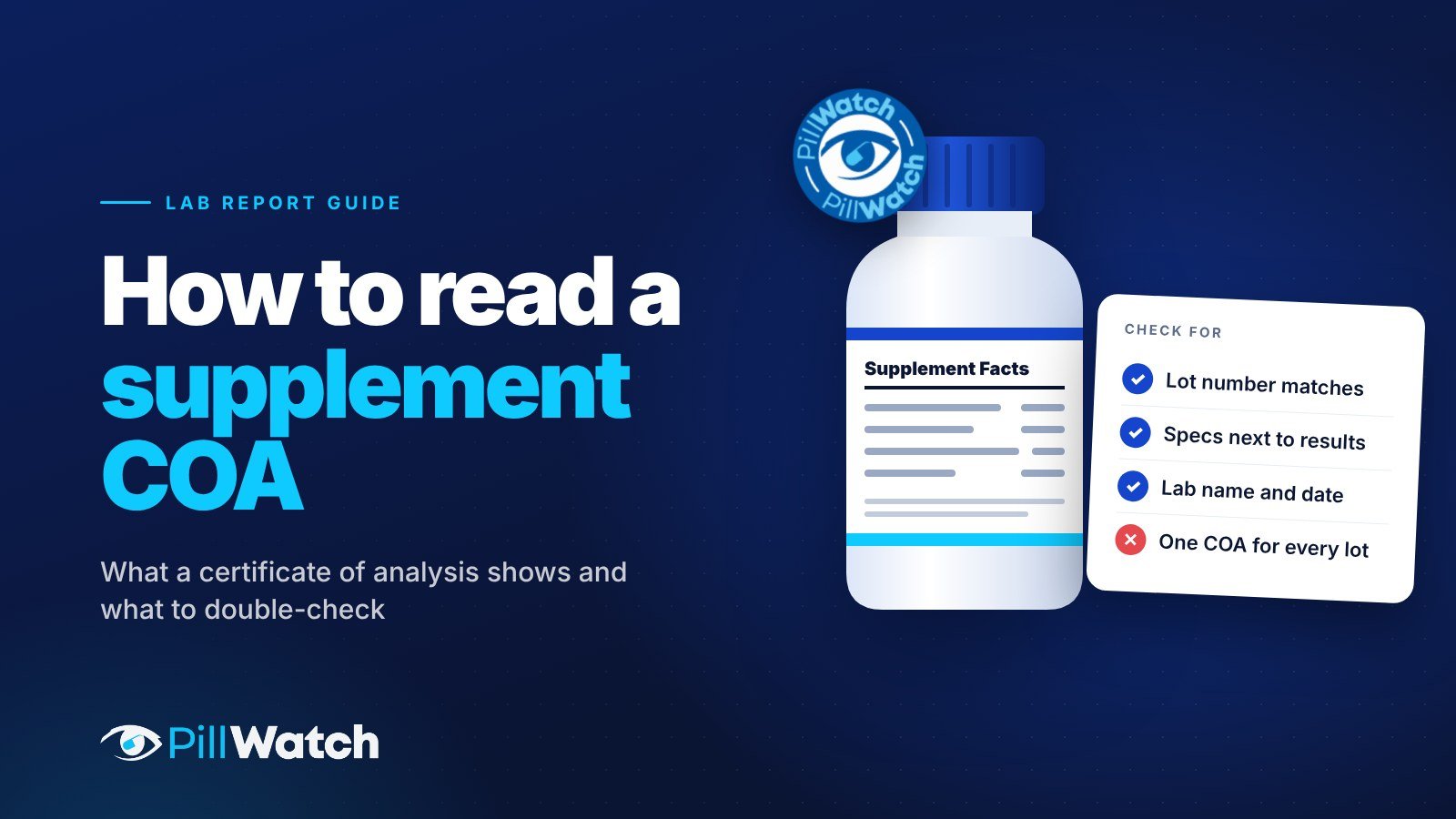
A supplement certificate of analysis (COA) is a lab report showing test results for one specific batch of a product. It tells you what was tested, what the acceptable limits were, and whether that batch passed.
A COA is useful for shoppers and brand owners, but it's easy to misread and easy to fake. This guide covers who issues COAs, what belongs on one, the red flags to watch for, and how to ask a brand for one.
What a COA is (and what it covers)
Think of a COA as a report card for a single production run. Supplements are made in batches, also called lots. Each lot gets a lot number, which is printed on the bottle. A COA ties test results to that lot number.
That detail matters. A COA only tells you about the batch it names. A clean COA from last year's batch says nothing certain about the bottle in your hand if the lot numbers are different.
Do supplement companies have to test their products?
Yes. U.S. supplement makers must follow current Good Manufacturing Practices in 21 CFR Part 111. Under those rules, a manufacturer has to:
- Set specifications for the identity, purity, strength and composition of each finished product, plus limits on contamination that could make it adulterated.
- Run at least one appropriate test or examination to confirm the identity of each dietary ingredient before using it.
- Verify that finished batches meet those specifications, either by testing every batch or a subset chosen with a sound statistical sampling plan.
Part 111 also explains when a manufacturer can rely on a supplier's COA for some incoming components. The company must first qualify the supplier by confirming the COA results with its own testing, and the COA must list the test methods, limits and actual results. The company then has to re-confirm the supplier's COA periodically.
What Part 111 does not do is require brands to publish COAs for shoppers. Testing records are kept for the company and for FDA inspectors. Sharing a COA with customers is voluntary. Keep in mind that FDA doesn't approve supplements before they're sold, which our post on whether supplements are FDA approved explains in more detail.
Who issues a COA
COAs usually come from one of two places.
In-house labs. Many manufacturers test their own products. That's allowed, and an in-house COA can be accurate. The catch is that the company is grading its own work.
Independent third-party labs. A "third-party COA" comes from an outside lab with no stake in whether the product passes. Many of these labs are accredited to ISO/IEC 17025, the international standard titled "General requirements for the competence of testing and calibration laboratories." According to ANAB, one of the U.S. accreditation bodies, the standard covers a lab's competence, impartiality and consistent operation, and helps labs show they can produce valid results. The current version is ISO/IEC 17025:2017.
One nuance: accreditation has limits. A lab's scope of accreditation lists the specific tests it is accredited to perform, as ANAB's FAQ explains. A lab might be accredited for heavy metals but not for microbiology, for example. Accreditation bodies such as ANAB and A2LA keep searchable directories, so you can look up a lab and its scope.
What's on a supplement COA
Layouts vary, but a solid COA usually includes:
- Product name that matches the label.
- Lot or batch number that matches the number printed on the bottle.
- Dates, such as the manufacture date, the test date and the report date.
- Specifications next to results. Each test should show the acceptable range and the actual measured value, often with a "pass" or "conforms" note.
- Identity and potency. Identity tests confirm the ingredient is what it claims to be. Potency (or assay) results show how much of an ingredient is present compared with the label.
- Microbiological tests. Common ones include total aerobic bacteria and total yeast and mold counts, plus checks for specific harmful organisms such as E. coli and Salmonella.
- Heavy metals. Look for lead, arsenic, cadmium and mercury. USP's General Chapter 2232 on elemental contaminants in dietary supplements focuses on these four as the main elements of toxicological concern.
- Test methods, such as a USP chapter or another named method.
- Lab details. The lab's name, address, a signature from the person who approved the report, and accreditation information if it's a third-party lab.
How to read the results
Start with the lot number. If it doesn't match your bottle, the rest of the report doesn't apply to you.
Next, scan the specification and result columns side by side. For contaminants, results should fall at or below the limit. For potency, results should fall within the stated range. "ND" usually means "not detected," and "LOQ" refers to the limit of quantitation, the lowest amount the method can reliably measure.
Then look at who signed it and when. A report dated before the product was made, or years after, deserves a closer look.
Red flags on a COA
Watch for these warning signs:
- The lot number doesn't match the bottle, or there's no lot number at all.
- No lab name, address or contact information.
- Results with no specifications. A number on its own doesn't tell you whether the batch passed.
- Dates that don't line up, like a test date before the manufacture date.
- A PDF that looks edited. Mismatched fonts, blurry logos, misaligned columns or numbers that look pasted in can all signal tampering.
- One COA reused for every batch. If a brand shows the same report no matter which lot you ask about, it isn't a batch-specific COA.
- Accreditation claims you can't confirm. If a lab claims ISO/IEC 17025 accreditation, it should appear in an accreditation body's directory with a matching scope.
If something looks off, you can contact the lab directly and ask whether it issued that report. Many labs will confirm whether a report number is genuine.
How to request a COA from a brand
Most brands that test their products will share COAs on request. Here's a simple approach:
- Find the lot number on your bottle. It's usually printed near the expiration date.
- Contact the brand through its customer service email or contact form.
- Ask for the COA for that specific lot, and say whether you want the finished-product report.
- Ask who did the testing. Was it an in-house lab or an independent lab? If independent, which one?
- Compare the report against your bottle using the checklist above.
A brand that won't share anything, or sends a generic report that doesn't match your lot, has told you something useful.
For brand owners
If you sell supplements, a clear COA practice builds trust. Keep finished-product COAs organized by lot number. Use labs whose scope of accreditation covers the tests you need. Be ready to send the right report quickly when a customer or retailer asks. Some brands also post COAs on their websites, sorted by lot.
COAs on a PillWatch verify page
The PillWatch Seal is about sourcing. We review documents showing a brand's products come from licensed manufacturers and distributors, and we keep checking marketplaces after the seal is issued. On a product's verify page, brands can also post lab certificates. PillWatch checks that a certificate is for that product, but the test results are the lab's, not ours. You can read exactly what we check, and brand owners can see seal plans.
Frequently asked questions
What is a COA for supplements?
It's a lab report for one batch of a supplement. It lists the tests performed, the acceptable limits and the actual results for that batch's lot number.
Are supplement brands required to share COAs?
No. Federal manufacturing rules in 21 CFR Part 111 require testing and records, but they don't require brands to make COAs public. Sharing them is voluntary.
What is a third-party COA?
It's a COA issued by an independent lab rather than the manufacturer's own lab. Many independent labs are accredited to ISO/IEC 17025, which you can confirm in an accreditation body's directory.
Does a clean COA mean a supplement is safe for me?
Not by itself. A COA covers one batch and only the tests that were run. The NIH Office of Dietary Supplements notes that even quality seals don't guarantee a product is safe or effective.
This article is for general information and isn't medical advice. Talk with a doctor or pharmacist before starting a supplement, especially if you take prescription medicine.
Sources: 21 CFR Part 111 (eCFR) · ANAB: ISO/IEC 17025 · ANAB FAQ · FDA: Questions and Answers on Dietary Supplements · NIH ODS: Dietary Supplements, What You Need to Know

The PillWatch Seal shows shoppers your products come from licensed sources.