How to Check If a Supplement Has Been Recalled (and What to Do)
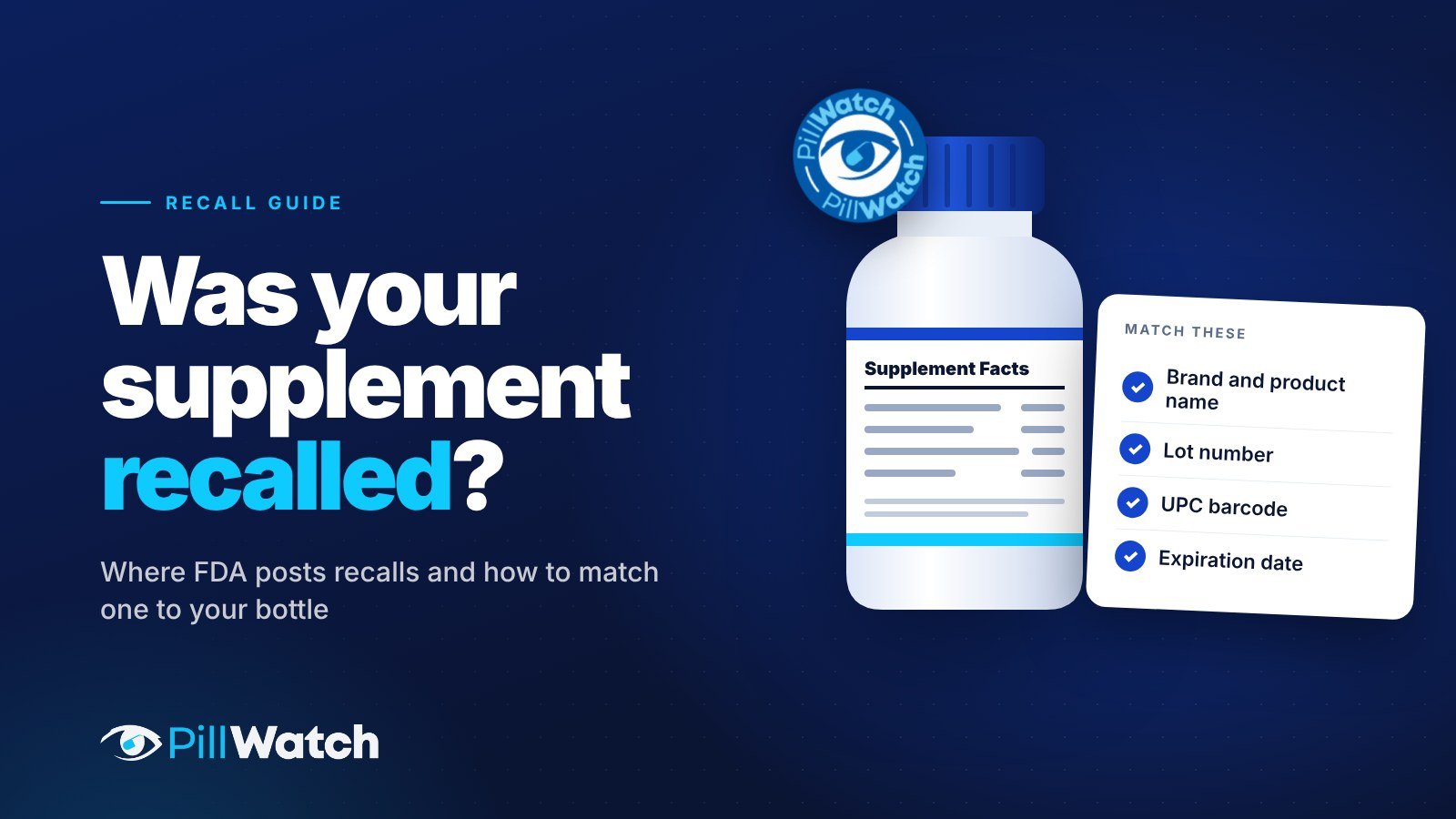
To check if a supplement has been recalled, search the brand and product name on the FDA's Recalls, Market Withdrawals & Safety Alerts page and in the weekly FDA Enforcement Report. If you find a recall, compare the lot number, UPC and expiration date on your bottle with the ones listed in the notice.
That's the short version. The details matter, because a recall usually covers specific batches, and the FDA's main recall page doesn't list every recall. Here's where to look and what to do if your bottle is a match.
Where supplement recalls are posted
There's no single list that catches everything, so it helps to know what each source covers.
FDA Recalls, Market Withdrawals & Safety Alerts
The FDA's recalls page is the easiest place to start. It's a searchable table with the date, brand name, product, reason for the recall and company. You can filter by product type and sign up for email alerts.
Keep one limit in mind. The FDA says this page is built from press releases and other public notices, and "not all recalls have press releases or are posted on this page." Notices also move to an archive after three years.
FDA Enforcement Report
The Enforcement Report is the more complete list. The FDA says it "includes all recalls monitored by FDA," including ones not yet classified. It's updated weekly and is searchable by product, company and recall class. It's less friendly to read, but if a recall exists, this is where you're most likely to find it.
openFDA
openFDA offers the same enforcement data in a format built for developers and researchers. The food enforcement data covers records from 2004 to the present and is updated weekly. Supplements are regulated as food, so that's the category to search. Most shoppers won't need it.
FDA MedWatch safety alerts
MedWatch is the FDA's medical product safety program. When appropriate, it publishes safety alerts about products the FDA is concerned about. Dietary supplements are among the product types it covers, and you can subscribe to the alerts by email.
PillWatch's recalls page
Our supplement recalls page pulls FDA recall data and MedWatch safety alerts into one place, so you can search a brand or product name without checking several sites. It's a convenience, not a replacement for the FDA's own records. For a final answer, check the FDA notice it links to.
How to match a recall to your bottle
Finding a brand name in a recall doesn't mean your bottle is affected. Recalls usually name specific batches. The Enforcement Report has a field for exactly this, which the FDA describes as a list of "lot and/or serial numbers, product numbers, packer or manufacturer numbers, sell or use by dates" that appear on the product.
Pull out your bottle and check these against the notice:
- Brand and product name. Match the exact product, including the flavor, strength and count. A recall of a 60-capsule bottle may not include the 120-capsule version.
- Lot or batch number. This is usually printed or stamped near the expiration date, on the bottom of the bottle or on the label edge.
- UPC. This is the number under the barcode. Some recalls list it to show which package sizes are affected.
- Expiration or best-by date. Recalls often name a date range.
If every detail matches, treat your product as recalled. If you can't find a lot number on the bottle, or the label is too worn to read, contact the company named in the notice and ask.
What Class I, II and III recalls mean
The FDA assigns each recall a class based on how much risk the product poses. Here are the FDA's definitions:
- Class I: "a situation in which there is a reasonable probability that the use of or exposure to a violative product will cause serious adverse health consequences or death."
- Class II: "a situation in which use of or exposure to a violative product may cause temporary or medically reversible adverse health consequences or where the probability of serious adverse health consequences is remote."
- Class III: "a situation in which use of or exposure to a violative product is not likely to cause adverse health consequences."
Class I is the most serious. A Class III recall still means something is wrong with the product, such as a labeling problem, even if it's unlikely to hurt you.
Recall, market withdrawal or safety alert
You'll see all three terms on the FDA's site. They mean different things.
- Recall. A company removes or corrects a product that breaks the law. This is what the class system applies to.
- Market withdrawal. The FDA uses this term when a product has "a minor violation that would not be subject to FDA legal action." The company pulls or fixes the product anyway.
- Safety alert. A public warning about a risk. The FDA's formal definition covers medical devices. For supplements, warnings usually come as MedWatch alerts or FDA public notices, and they can appear even when no recall has happened.
Who decides to recall a supplement
Most recalls start with the company. The FDA's openFDA documentation says it plainly: "Recalls are almost always voluntary, meaning initiated by a firm." The FDA can also request a recall, and companies usually go along with it.
The FDA does have power to force one. The Food Safety Modernization Act (FSMA) gave the agency authority to order a food recall, and the FDA's guidance confirms that "food" includes dietary supplements. To use it, the FDA must find a reasonable probability that the product is adulterated or misbranded and that it will cause serious health problems or death. Even then, the FDA must first give the company a chance to recall the product on its own.
What to do if your supplement is recalled
- Stop using it. The FDA tells consumers to stop using a supplement they think caused a problem. The same goes for one that's been recalled.
- Follow the recall notice. The notice will say whether to return the product, throw it away or contact the company for a refund. Keep the bottle until you've read the instructions, since you may need the lot number or proof of purchase.
- Talk to your doctor if you had symptoms. Bring the bottle or a photo of the label so they can see exactly what you took. Get emergency care for a serious reaction.
- Report the problem. The FDA asks people to report supplement side effects through the Safety Reporting Portal. Include the product name, lot number and what happened.
Check the FDA's tainted products list too
Some of the riskiest products sold as supplements contain hidden prescription drug ingredients. The FDA tracks these in its Health Fraud Product Database, which lists products named in warning letters, recalls and public notices, along with the hidden ingredient found.
The FDA is clear that the list is incomplete. It "only includes a small fraction of the potentially hazardous products" on the market. A product that isn't listed isn't automatically safe. Our guide to why supplements aren't FDA approved explains why problems like these are usually caught after products are already sold.
Where PillWatch fits
PillWatch's recalls page is a free way to search FDA recalls and safety alerts in one place. Separately, brands with the PillWatch Seal have shown documents that their products come from licensed manufacturers and distributors, and we check marketplaces each month after the seal is issued. The seal is about sourcing. It isn't FDA approval or a lab test, and you can see exactly what we check or verify a seal ID.
Frequently asked questions
Is there one complete list of supplement recalls?
The FDA's weekly Enforcement Report is the closest thing, since it includes every recall the FDA monitors once classified. The FDA's main recalls page is easier to search but doesn't post every recall.
Can I get a refund for a recalled supplement?
Often, yes. The recall notice explains how to return the product or contact the company. Keep the bottle and your receipt until you've followed those steps.
Does a recall mean everyone who took the product will get sick?
No. The recall class tells you how serious the risk is. If you took the product and feel unwell, talk to a doctor.
How do I get alerts about new recalls?
You can sign up for email updates from the FDA's recalls page and subscribe to MedWatch safety alerts. You can also check our recalls page before you buy.
This article is for general information and isn't medical advice. Talk with a doctor or pharmacist before starting a supplement, especially if you take prescription medicine.
Sources: FDA: Recalls, Market Withdrawals & Safety Alerts · FDA: Recalls Background and Definitions · FDA: Enforcement Reports · openFDA: Food Enforcement · FDA: Mandatory Food Recalls Guidance · FDA: How to Report a Problem with Dietary Supplements
The PillWatch Seal shows shoppers your products come from licensed sources.