What Does GMP Certified Mean on Supplements? A Shopper's Guide
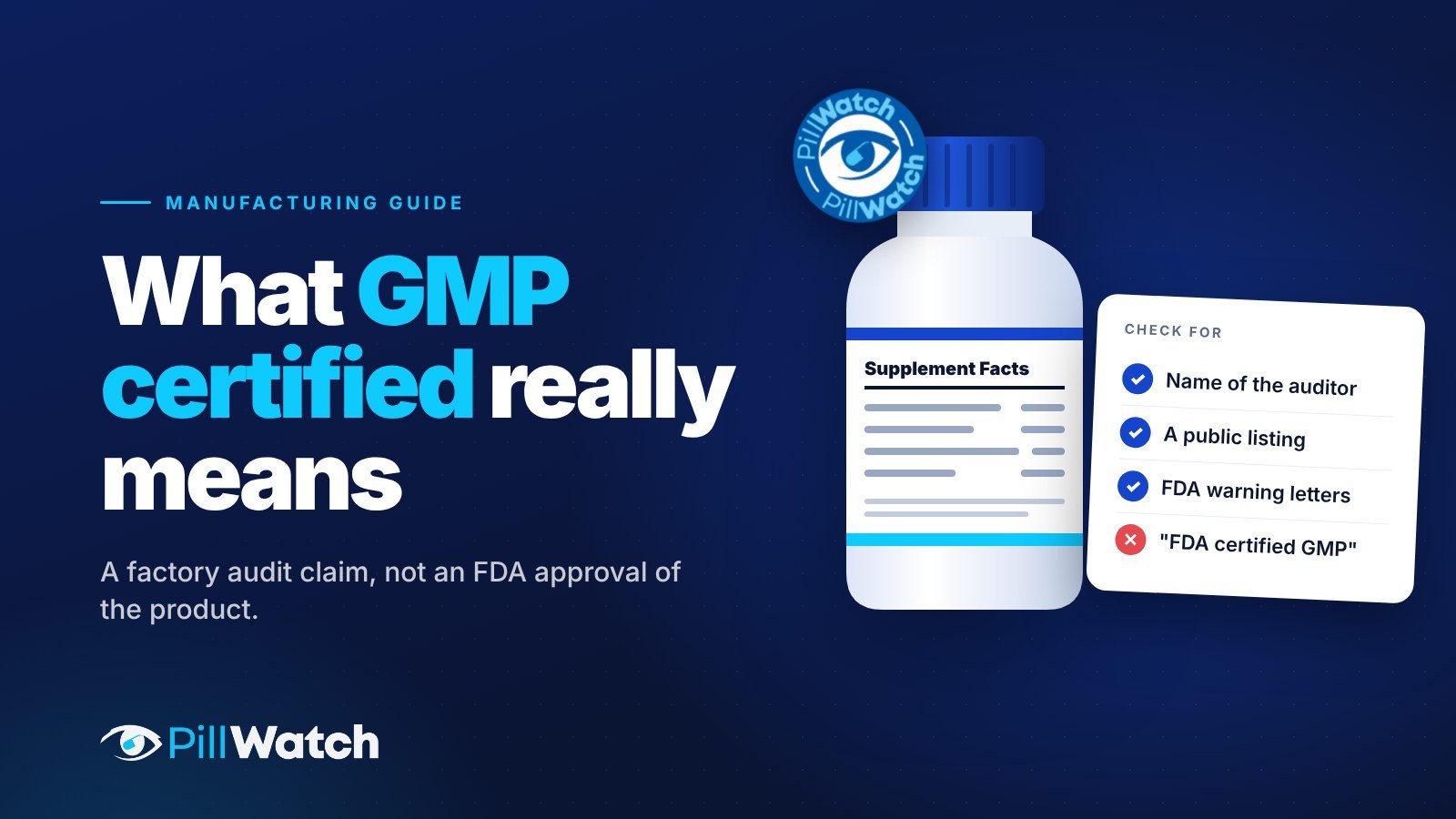
"GMP certified" on a supplement means a private auditor inspected the factory that made it and found it was following good manufacturing practices. It is a claim about how the product was made, and it doesn't mean the FDA approved the supplement or tested what's in the bottle.
GMP stands for Good Manufacturing Practices. In the U.S., the version that applies to supplements is called cGMP (the "c" means current), and following it is the law for every company that makes supplements sold here. Here's what those rules cover, who hands out "GMP certified" badges, and how you can check a claim yourself.
What cGMP means for supplements
The FDA's manufacturing rules for supplements are in 21 CFR Part 111, finalized in 2007. The FDA says these practices help ensure "the identity, purity, quality, strength, and composition" of a supplement.
Part 111 applies to anyone who manufactures, packages, labels or holds a dietary supplement. That includes products imported into the U.S. A store that simply holds supplements for retail sale is exempt from the holding rules.
Some of the main requirements:
- Specifications. A company has to set written specifications for the ingredients, each key step in production, the finished product, and the packaging and labels.
- Identity testing. For every dietary ingredient, the maker must run at least one appropriate test or exam to confirm it is what it claims to be. The rule allows FDA to grant an exemption through a petition, but the default is testing.
- Master manufacturing record. Each formula and batch size needs a written "recipe" that the factory follows, so every batch comes out the same.
- Batch production record. Every time a batch is made, the factory has to record complete details of how it was made and controlled, and that record has to follow the master record.
- Quality control. Quality control staff approve or reject ingredients, processes and finished batches before products go out.
- Reserve samples. The maker keeps samples of each lot it ships, so problems can be checked later.
- Complaints. A qualified person has to review every product complaint and investigate any that could point to a quality failure, including one that could cause illness or injury.
- Records. Required records have to be kept for 1 year past the shelf life date, or for 2 years after the last related batch ships if there's no shelf life date.
None of this is optional. If a supplement is sold in the U.S., its maker is already required to follow Part 111, whether or not the label says "GMP" anywhere.
Is "GMP certified" the same as FDA approved?
No. The FDA doesn't approve supplements before they're sold. In its own words, "by law, FDA does not approve dietary supplements or their labeling." We cover that in more detail in are supplements FDA approved?
The FDA checks whether companies follow cGMP mainly by inspecting facilities. When a label says "GMP certified," the certificate almost always comes from a private organization that audits factories. The FDA has said it doesn't issue certificates of registration to food facilities, which include supplement facilities, and it doesn't recognize registration certificates sold by private businesses.
So be skeptical of phrases like "FDA certified GMP" or "FDA GMP approved." Those wordings suggest an FDA stamp that doesn't exist.
Who actually certifies GMP
Several independent groups audit supplement makers against GMP standards. Two you'll see often:
- NSF. NSF offers GMP certification for dietary supplements under a standard called NSF/ANSI 455-2. NSF describes it as covering regulatory requirements, retailer quality requirements and industry best practices. NSF also offers a separate GMP registration program.
- Natural Products Association (NPA). NPA has run a GMP certification program since 1999 and says it was the first group to offer third-party GMP certification. After FDA's 2007 rule, NPA says it built all the federal requirements into its standard.
Keep in mind what these programs look at. A GMP audit reviews a facility and its systems at a point in time. It doesn't, by itself, test every bottle on the shelf. Some groups, including NSF, run separate product certification programs that do involve testing, and those are a different thing from GMP certification.
What an FDA warning letter is
When the FDA believes a company has committed significant violations of the law, it can send a warning letter. The letter lists the problems, such as poor manufacturing practices, and asks the company to respond within a set time.
A warning letter is a serious sign, but it isn't the final word. If the FDA later confirms the company fixed the problems, often through a follow-up inspection, it may issue a close-out letter. The FDA won't issue one based only on promises.
The FDA posts warning letters publicly on its warning letters page. The table lists the company name, subject and issuing office. To search it:
- Go to the warning letters page.
- Type the brand name, or the manufacturer's name, into the search box.
- Read the subject line. Supplement manufacturing cases often mention "CGMP" and "Dietary Supplement."
- Check the closeout column to see whether the FDA later closed the matter.
How to check a "GMP certified" claim
You can't audit a factory yourself, but you can check whether a claim holds up:
- Find out who certified it. A real claim names the certifier, such as NSF or NPA. A plain "GMP certified" badge with no name tells you very little.
- Look it up on the certifier's site. Certification groups keep public listings. NSF has a search for certified products and systems, and NPA lists GMP certified companies on its site.
- Know which company to search. Many supplement brands use a separate contract manufacturer. The label may only name the company that sells the product. If you can't tell who made it, ask the brand.
- Search FDA warning letters. Check both the brand name and the manufacturer's name using the steps above.
- Check for recalls. Search the product or company on our supplement recalls page.
- Ask the brand. A brand that takes quality seriously can usually tell you who audits its manufacturer and when the last audit was.
Counterfeits are a separate risk. A fake copy of a product made in a certified facility can still carry the same badge. Our guide on how to spot counterfeit supplements covers how to check the seller.
If you run a supplement brand
Following 21 CFR Part 111 is the legal baseline, so a GMP certificate mainly helps you show buyers and retailers that someone outside your company has checked it. Keep your manufacturer's audit certificates current, know when each one expires, and be ready to share the certifier's name when a shopper or retailer asks. If you use a contract manufacturer, keep in mind that FDA's rules still apply to anyone who packages, labels or holds your product.
Where the PillWatch Seal fits
GMP certification looks at how a product is made. The PillWatch Seal looks at a different question: where it comes from. We review documents showing a brand's products come from licensed manufacturers and distributors, then check marketplaces monthly for problems. The seal isn't FDA approval or a lab test, and you can see exactly what we check or confirm a seal on our verify page.
Frequently asked questions
Does the FDA certify supplement factories for GMP?
The FDA inspects supplement facilities and can take action when they break the rules, but "GMP certified" badges usually come from private auditors such as NSF or NPA. The FDA also doesn't approve supplements before they're sold.
What is cGMP for supplements?
It's the set of FDA manufacturing rules in 21 CFR Part 111. They cover things like ingredient identity testing, batch records, quality control and complaint handling.
Do all supplements have to be made under GMP?
Yes. Anyone who makes, packages, labels or holds supplements sold in the U.S. must follow Part 111. A "GMP certified" label only means an outside group also audited the facility.
How do I find out if a supplement company got an FDA warning letter?
Search the company name on the FDA's warning letters page. Letters are posted publicly, and the page shows whether a close-out letter was issued later.
This article is for general information and isn't medical advice. Talk with a doctor or pharmacist before starting a supplement, especially if you take prescription medicine.
Sources: 21 CFR Part 111 (eCFR) · FDA: Questions and Answers on Dietary Supplements · FDA: About Warning and Close-Out Letters · FDA: Registration Fees and Private Certificates · NSF: GMP Certification · NPA GMP Certification Program
The PillWatch Seal shows shoppers your products come from licensed sources.