How to Read a Supplement Label: What Every Line Means
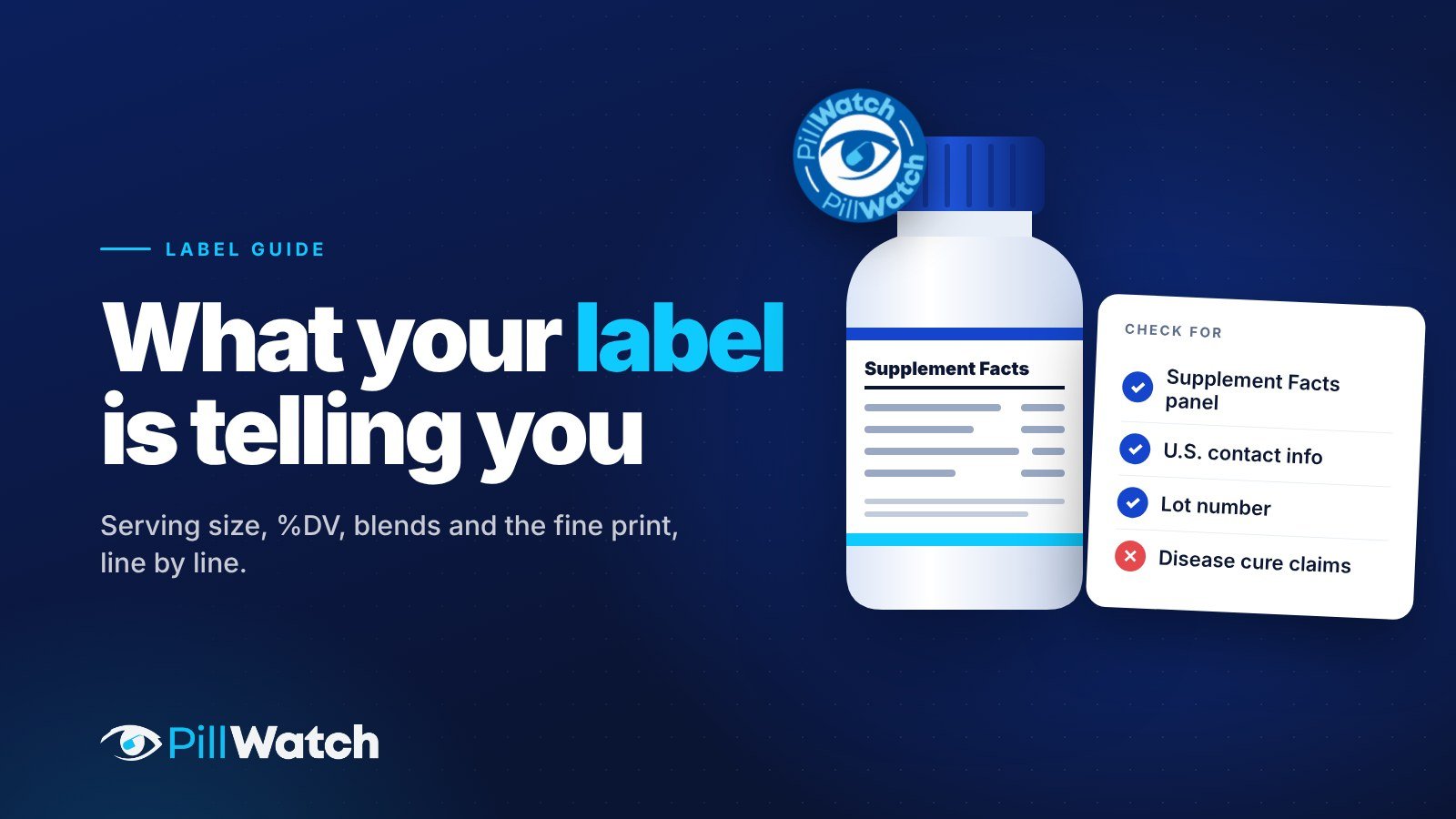
To read a supplement label, start with the Supplement Facts panel: check the serving size, the amount of each ingredient per serving and its % Daily Value. Then read the "other ingredients" list, find the company's name and U.S. contact information, and look closely at any health claims on the bottle.
Every supplement sold in the U.S. follows the same basic labeling rules. Here's what each part means and what to watch for.
The five things every supplement label must have
FDA's labeling rules require five statements on a dietary supplement label:
- Statement of identity. This is the product's name, and it must include the words "dietary supplement." The word "dietary" can be swapped for the type of ingredient or its name, as in "herbal supplement" or "fish oil supplement."
- Net quantity of contents. How much is in the container, shown as a count (like 60 capsules), a weight or volume, or both.
- Nutrition labeling. This is the Supplement Facts panel.
- Ingredient list. The "other ingredients" that aren't listed in the panel.
- Name and place of business of the manufacturer, packer or distributor.
The product name and net quantity go on the front of the package, called the principal display panel. The Supplement Facts panel, the ingredient list and the company name and address can go on the front or on the information panel, which is usually the side of the bottle.
Two more items show up on most labels. If the product makes a claim about how it affects the body, it must carry an FDA disclaimer (more on that below). Labels also must include a domestic address or domestic phone number where you can report serious side effects to the company.
How to read the Supplement Facts panel
Serving size
The serving size sits right under the "Supplement Facts" title. Under FDA rules, one serving is the maximum amount the label recommends taking at one time, such as 2 capsules or 1 scoop. If the label doesn't recommend an amount, one serving is one unit, like one tablet.
Every number below it is per serving. If the serving size is 3 capsules, the amounts listed are for all 3 capsules together.
Amount per serving
Under the heading "Amount Per Serving," the panel lists each dietary ingredient and how much of it is in one serving, usually in milligrams (mg), micrograms (mcg) or grams (g).
The amount listed is the weight of the nutrient itself, not the compound it comes from. You'll often see the source in parentheses, like "Calcium (as calcium carbonate)." For herbal ingredients, the panel must also name the part of the plant used, such as root, leaf or seed.
% Daily Value
The % Daily Value (%DV) column tells you how much of a nutrient one serving provides compared with a reference amount FDA has set for that nutrient. A %DV of 50% means one serving gives you half the Daily Value. You may see numbers above 100%.
The %DV is a reference point for comparing products. It isn't a personal recommendation.
Ingredients without a Daily Value
Many supplement ingredients, like herbs, fish oils or amino acids, don't have a Daily Value. These are still listed in the panel by name, with their amount per serving, after the vitamins and minerals. Instead of a percentage, you'll see a symbol (often an asterisk) that points to a footnote reading "Daily Value not established."
Other ingredients
Below the panel, you'll find a separate list of ingredients that aren't in the Supplement Facts box. These are things like fillers, binders, capsule shells, flavors and colors. Check this list if you have allergies, follow a specific diet or want to avoid certain additives.
What a proprietary blend does and doesn't tell you
A proprietary blend is a mix of ingredients grouped under one name, like "Proprietary Blend" or a branded name the company made up. Blends are legal.
Here's what the label must show for a blend:
- The blend's name
- The total weight of the blend's ingredients per serving
- Each ingredient in the blend, listed in order from the largest amount by weight to the smallest
- Any vitamins or minerals with a Daily Value, listed with their own amounts
Here's what it doesn't have to show: the amount of each individual ingredient without a Daily Value inside the blend. If a 500 mg blend lists five herbs, you know the first herb is the largest share, but it could be anywhere from about 100 mg to nearly all 500 mg. The last ingredient on the list could be a tiny amount.
Blends aren't automatically bad, but you can't tell how much of any single ingredient you're getting.
Claims and the FDA disclaimer
Supplements can say how an ingredient affects the body's structure or function, such as "supports bone health." These are called structure/function claims, and FDA doesn't approve them before they're used. The company has to notify FDA within 30 days after it first markets a product with the claim.
Any label with one of these claims must include this disclaimer: "This statement has not been evaluated by the Food and Drug Administration. This product is not intended to diagnose, treat, cure, or prevent any disease." It must sit right next to the claim, or appear in a box on the same panel linked by a symbol like an asterisk.
When you see that disclaimer, read it literally. FDA has not checked whether the claim is true. Our post on whether supplements are FDA approved explains why.
Lot numbers and expiration dates
Lot number. FDA's manufacturing rules require companies to assign a batch, lot or control number to each lot of finished supplement, so they can trace its history. The labeling rules don't list a lot number among the required label statements, but brands commonly print one on the bottle or box. It's what recall notices use to say which bottles are affected.
Expiration date. Expiration dates aren't required on supplements. Many brands print one anyway, and FDA's guidance says a company should have data to support any date it puts on the label.
Red flags on a supplement label
Watch for these when you're reading a label:
- No Supplement Facts panel, or a panel that looks copied, blurry or misspelled
- No company name or U.S. contact information, or only a website
- Claims to treat, cure or prevent a disease, like "cures diabetes" or "treats arthritis," which supplements aren't allowed to make
- "FDA approved" on the bottle, since FDA doesn't approve supplements
- A missing disclaimer next to a claim about how the product affects the body
- No lot number anywhere on the package
- One big proprietary blend paired with promises of fast, drug-like results, especially for weight loss, sexual enhancement or muscle building
- "Natural" used as a promise of safety, since natural doesn't always mean safe
If something seems off, check our supplement recalls page for the brand or product, and read our guide on how to spot counterfeit supplements.
Where the PillWatch Seal fits
A label tells you what a company says is in the bottle. It can't tell you where that bottle actually came from. The PillWatch Seal focuses on that question: we review documents showing a brand's products come from licensed manufacturers and distributors, then check marketplaces monthly for problems. It isn't a lab test or FDA approval, and you can see exactly what we check or look up a seal ID on our verify page.
Frequently asked questions
What does % Daily Value mean on a supplement?
It compares the amount of a nutrient in one serving with a reference amount set by FDA. It isn't a personal dosage recommendation.
Do supplements have to list every ingredient?
Yes. Dietary ingredients go in the Supplement Facts panel, and other ingredients like fillers and capsule shells go in a separate list. Proprietary blends must name every ingredient, but they only have to give the blend's total weight.
Is an expiration date required on supplements?
No, but many brands include one. FDA's guidance says the company should have data to back up the date.
Where do I report a bad reaction to a supplement?
Tell your doctor, contact the company using the U.S. address or phone number on the label, and report it to FDA at 1-800-FDA-1088.
This article is for general information and isn't medical advice. Talk with a doctor or pharmacist before starting a supplement, especially if you take prescription medicine.
Sources: FDA: Dietary Supplement Labeling Guide · 21 CFR 101.36 · 21 CFR 111.415 · FDA: Questions and Answers on Dietary Supplements · FDA: Small Entity Compliance Guide for Dietary Supplement CGMP · NIH ODS: Dietary Supplements, What You Need to Know
The PillWatch Seal shows shoppers your products come from licensed sources.